👣 Quick start: your first plants
Six steps to bring life to a world. In the desktop app, 🎓 Tutorials in the menu walks you through the same, with Marles Tarwin.
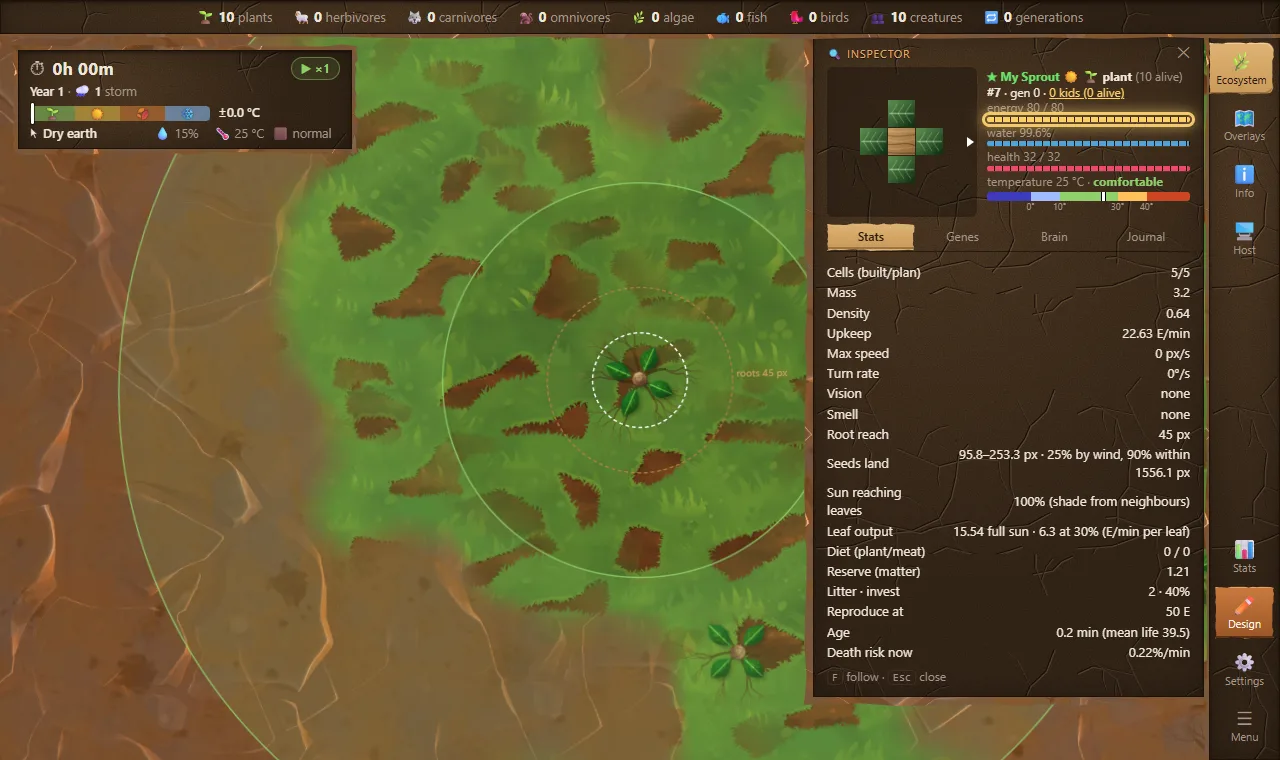
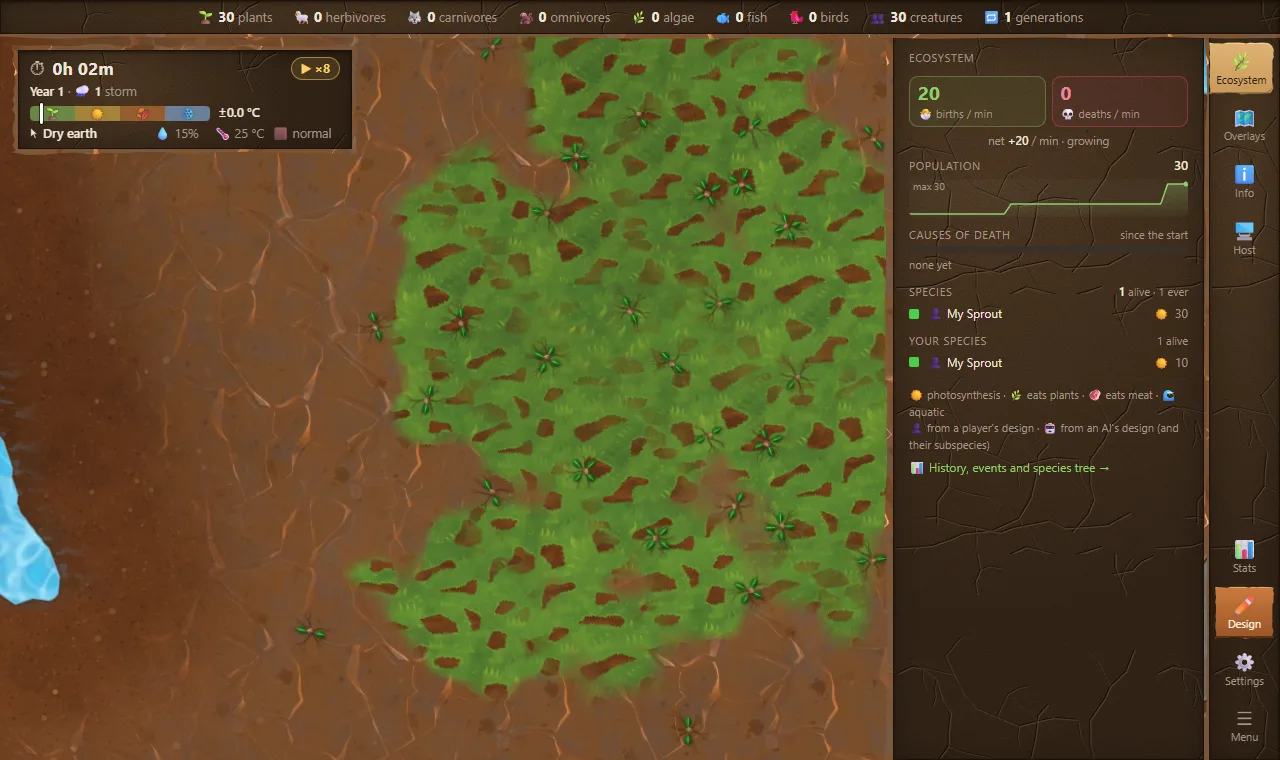
🚀 Getting started
An evolution sandbox. Nothing is scripted: creatures live, eat, drink, breed with small random changes, and get eaten. Whatever survives and breeds best spreads, and over time new bodies, behaviours and species appear on their own.
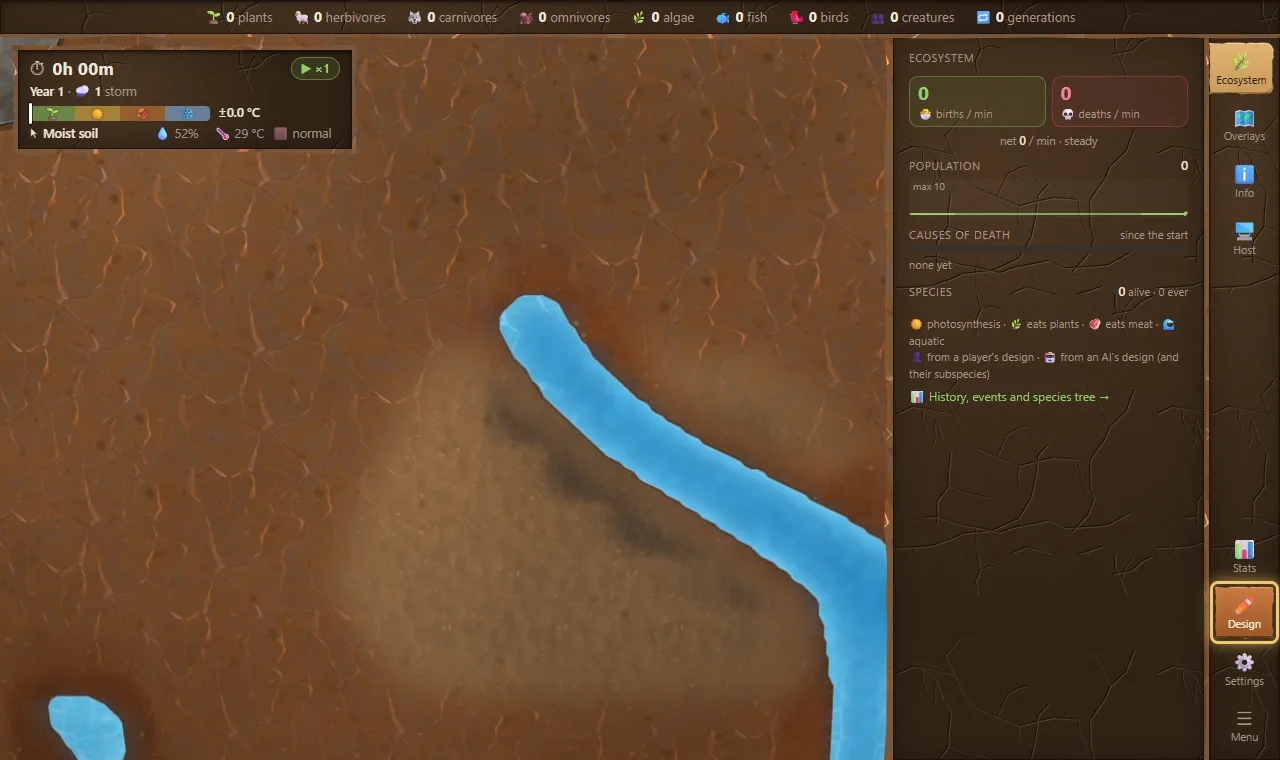
Pan and zoom around the planet, click any creature to see its body, genes, brain and life story, and follow how species rise and fall on the stats page.
Build your own species: a body of cells, its genes and a brain. The designer tells you what your design is (plant, grazer, hunter…).
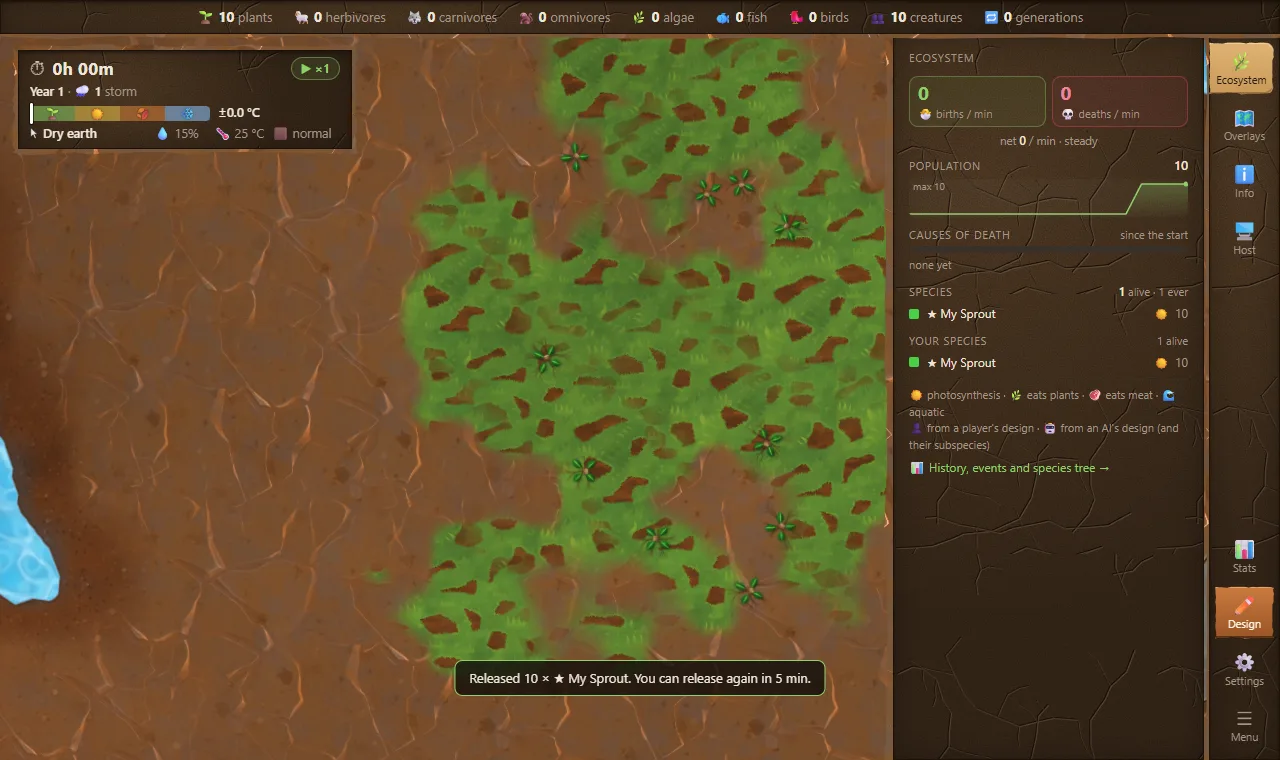
Drop 10 to 25 grown copies where you click. From then on they live, mutate and evolve by themselves. You can release again every 5 minutes.
Young are mutated copies. Selection keeps what works where it lives: a lineage in the cold grows fur, one in a desert turns succulent, one that hears others may learn to talk.
🎓 New here? In the desktop app, Tutorials in the menu teach the basics in three short guided lessons: plants, plant eaters and meat eaters.
Controls
| Move around | Drag, or WASD · zoom with the wheel or + - · 0 zooms all the way out |
|---|---|
| Creatures | Click one to inspect it (its bars on top, the rest in tabs: Stats, Genes, Brain, Journal) · F follow it · X show or hide creatures when zoomed out · U natural look or cells |
| Map views | O planet or flat map · L light · N nutrients · B water depth · T temperature · Y soil moisture · A radiation · C colour by species · G grid · R clouds |
| Controlling a creature | One of your own species: see Designing a creature |
| Signs | H damage rings · V speech bubbles · Esc closes panels · a right-click on the map puts everything away |
| Panels | The tabs on the right: 🌿 Ecosystem (births, deaths, population, species), 🗺️ Overlays (the map views as buttons) and ℹ️ Info (the guide, the Chronicle, the stats and the shortcuts). 📊 Stats, ✏️ Design and ⚙️ Settings sit at the bottom. On a phone the tabs are the bar along the bottom |
| Settings | Graphics quality (Auto adjusts it to your device), what shows on creatures, music and sound effects (J turns the music on or off) |
| Hosting a world | In the desktop app, the world you host runs on your computer and gets a 🖥️ Host tab: the speed (pause, ×1 to ×32, or Auto), how hard your computer works, who is watching, and ⏹ Stop server (it saves first) |
| Chronicle | 📜 Chronicle in the Info tab: the history of the world in reports of 10, 100 and 1000 years, and Right now. See AI and the Chronicle |
| God mode | Meteorites, heat and cold rays, bombs, extinction events on demand: see God mode |
| All shortcuts | ⌨️ Shortcuts in the Info tab, or ? |
⚡ Energy and matter
Two currencies run everything. Energy flows one way: in from the sun, out as the cost of living. Matter cycles: it is never made or lost, only passed around.
⚡ Energy (E)
Only leaves make energy, from sunlight. Animals get it by eating. Every creature burns energy just to stay alive (its upkeep), more when it moves. Big bodies, many organs and a big brain all add to the bill.
Out of energy, a creature starves: it loses health until it eats again or dies.
Each step up a food chain loses most of the energy, so there is always far more plant than animal, and far more plant eaters than hunters.
🪨 Matter (M)
Matter is what bodies are built from. The planet holds a fixed amount, in soil, air, bodies and carcasses.
Roots pull it out of the soil; eaters take it from what they eat.
When something dies, its matter goes back to the soil (animals as a carcass that rots away). Part of it rises into the air and comes down with the rain, so rainy places get richer and dry ones poorer. The sea keeps its own balance with the land: the clouds carry nutrients up from it and rain most of them on land, and the richer the sea gets compared with when the world began, the less rain feeds it and the more it gives back (and the other way round when it gets poor).
🌍 The planet
A round world: walk east long enough and you come back from the west. The far north and south are impassable. Zoom out to see the globe; zoom in and the ground is flat.
Each world has its own map of ocean, continents, islands, lakes and rock. Deep water keeps land animals apart, so each landmass evolves its own life.
Shallow water can be waded (slowly); deep water blocks land animals. Water is where animals drink, and it keeps the climate around it mild.
The ground's colour shows its nutrients compared with the land when the world began: pale sand is poor, dark earth is rich (N shows them). Roots drain the soil, the dead feed it, and rain moves nutrients around. Coasts are richer than the deep sea.
☀️ Sunlight
The sun stands over the equator: light is strongest in the middle of the map and fades toward the poles. There is no day and night. Rain clouds and some extinction events take light away for a while.
🌡️ Temperature
Press T to see it. It is warm at the equator and cold toward the poles. The sea keeps coasts mild, while the middle of a continent is hotter or colder. Volcanoes and fresh craters heat the land around them, and the seasons and extinction events shift the whole world.
Each body is comfortable in its own band, set by its insulation. Outside it, heat and cold cost energy. Cold never hurts directly, but a body that starves keeping warm freezes. Above 70 °C everything burns.
🌧️ Rain, wind and seasons
Storms are big rain clouds that drift with the wind. Like on Earth they come in belts: most form near the equator, a second band around 50° north and south, and few around 20 to 35°, where the deserts are. Each carries its own load of water, more in the darker clouds: its rain on land uses it up, so a storm with a small load runs dry over land before its time (4.5 to 12 sim-minutes) is up, while one out over the sea keeps its water. They also carry nutrients from the air and rain them down where they pass. Under rain, roots take up 2× the nutrients, leaves get 30% less light, and animals sip some water.
The wind blows in bands as on Earth: from the east near the equator, from the west in the middle latitudes.
Seasons: a year lasts 40 sim-minutes, with the bar at the top left showing where it is. Winter is cold and rainy, summer warm and dry: in summer hardly any new storms form, but the ones left over from spring drift on until they run dry, and there is always at least one somewhere. Over many years a slow climate cycle also warms and cools the whole world.
Water in the land: rain wets the ground and warmth dries it, while the land by water stays moist. Plants need it. Y shows it, and the panel at the top left describes the ground under the mouse (desert, heath, fertile soil, swamp…). Its – button shrinks that panel to the sim time and speed, and + shows it all again.
🧊 Ice
Where it is cold enough, shallow water freezes. Land animals can walk on ice, so a cold spell can open a bridge between islands, while algae and fish caught in it die.
🌱 Plants
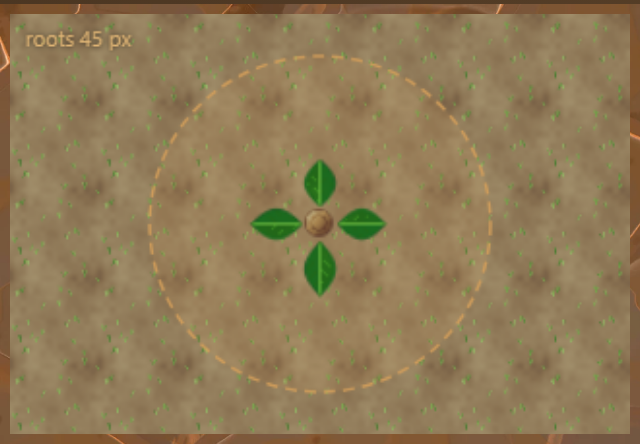
A plant is a body without muscles: leaves catch light, a root draws matter from the soil. They can't move, so where their seeds land is everything.
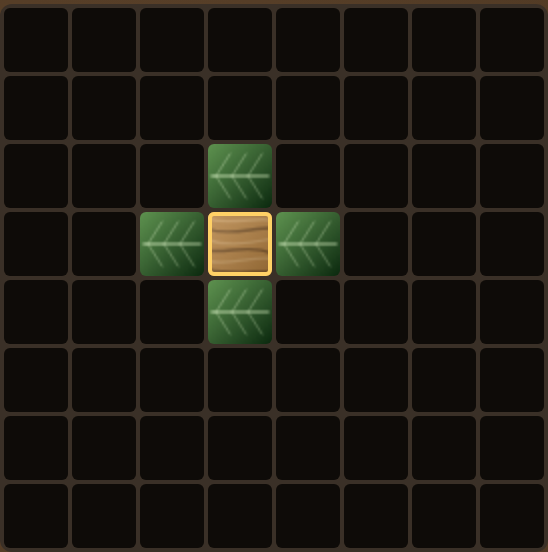
🔎 Example: the Sprout template
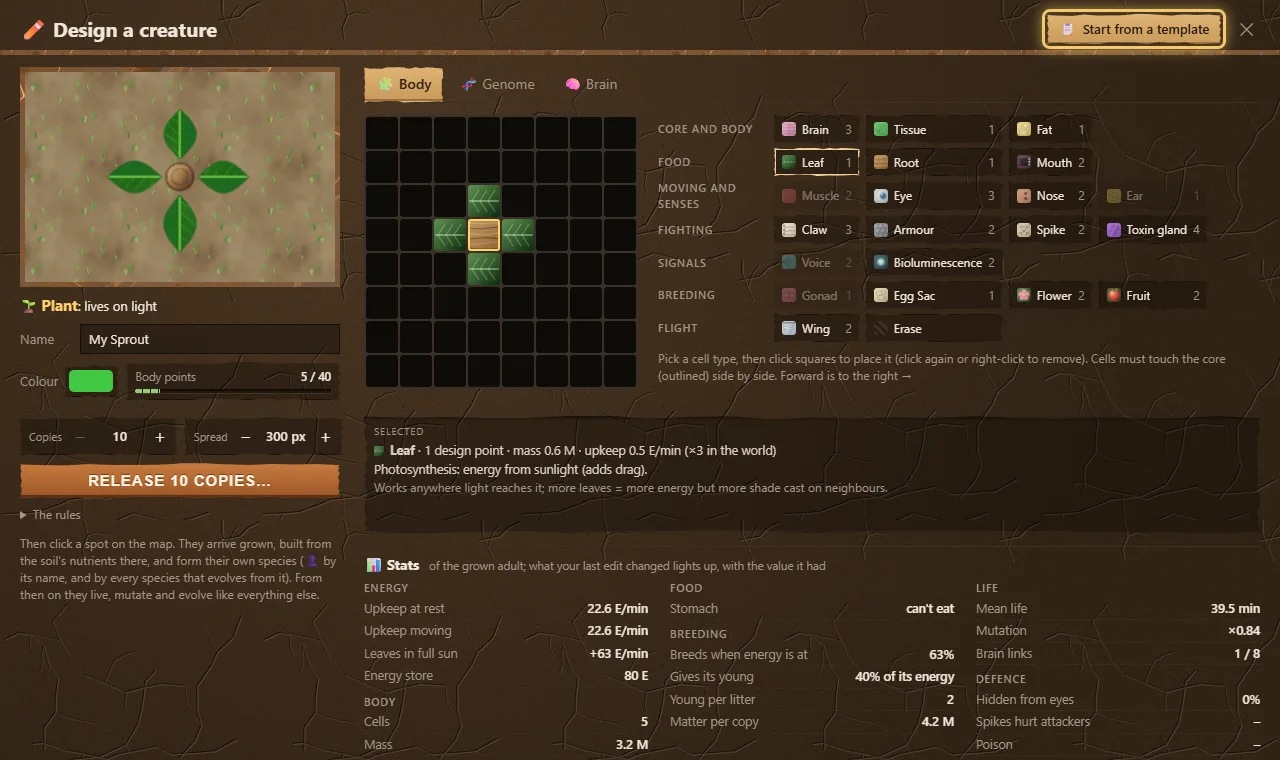
The simplest plant in the designer: a Root core with four Leaves around it. In full sun its leaves earn several times what the body burns.
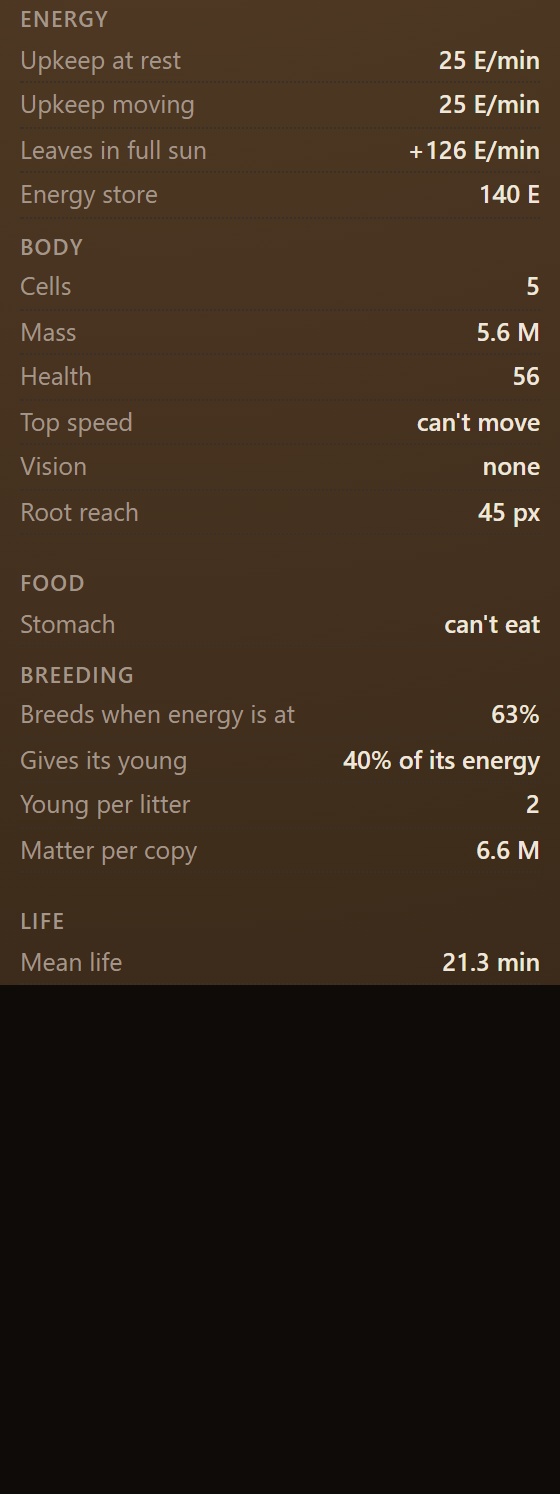
🍃 Leaves and light
Each leaf makes energy from the light on it. The Photosynthesis gene trades efficiency against damage: efficient leaves do well in dim light but burn in strong sun.
Shade: leafy neighbours steal each other's light, big plants far more than small ones. Seedlings under a big plant often starve.
🌰 Seeds
A grown, well-fed plant makes seeds. Most land near the parent (the Dispersal gene sets how far), and some are carried far by the wind, now and then even to an island. A grazed plant keeps its root and regrows, if it has the energy.
Costly, but animals eat it and carry its seed far away.
A plant's sex organ: the wind pollinates it from a flowering plant of its species nearby, and its seeds mix both parents.
Very aquatic plants live only in water, rooted on the floor. They feed the fish. Light fades with depth, so they grow best in the shallows.
Plants made for heat turn succulent, and the most heat-adapted become cacti.
🐾 Animals
An animal is a body with muscles. Designed animals have a Brain at their core. To live, it must find food and water faster than it burns energy.
🔎 Example: the Grazer template
A plant eater: a Brain core, a Mouth at the front (forward is to the right), an Eye on each front corner, Muscles to walk, a Nose to smell plants out of sight and a Fat cell for reserves. Its brain walks it to plants, eats, flees when hurt and rests when full.
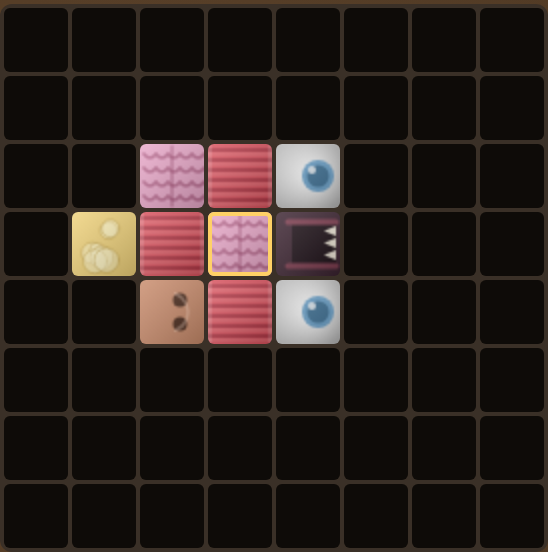
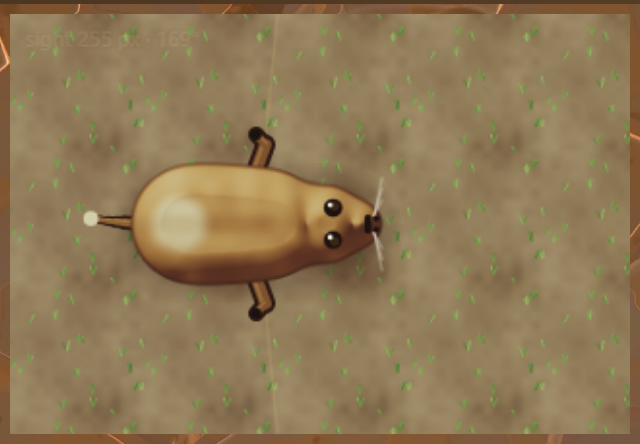
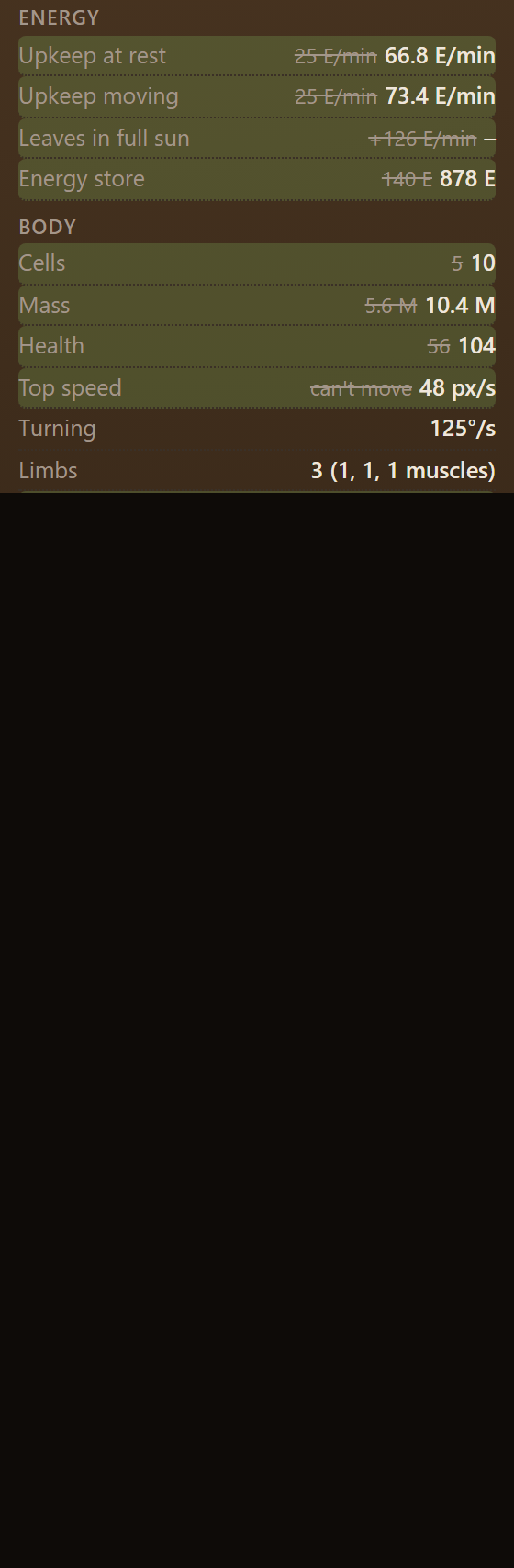
Muscles that touch side by side make one limb (touching only at a corner doesn't count). Longer limbs run faster: one limb of four muscles pushes harder than four single muscles. More limbs turn faster, though each extra limb adds less. Where a limb sits on the body doesn't matter. The designer shows the limbs, the top speed and the turning.
A mouth bites what it touches: plants, live animals or carcasses. Food goes into the stomach and is digested over time. What it gets depends on its digestion genes: food it can't digest is useless.
Plant eaters, meat eaters and omnivores (both digestions high enough) each have their place. Specialists digest best. A meat eater rests cheaply and stores a lot of energy, so one kill lasts it a long time. Plant roots grow underground, out of reach of most eaters.
Animals carry a little water and drink with the mouth next to water; they get thirsty faster in the heat and when running. Without water they lose health. Land plants drink too, through their roots, from the soil's moisture.
Claws strike what they touch when the brain attacks, then rest a moment; more claws strike more often. They need muscles.
Armour blunts claws but is heavy. Spikes hurt whatever bites or claws the body, on plants too, as thorns. Toxin glands poison whatever eats from it: a toxic plant can kill a grazer with one meal.
A dead animal leaves a carcass that rots away over minutes, losing its value. Scavengers live on them.
A mouth never bites a live animal of its own species (claws can). Animals can give energy to whoever they touch.
Wings let an animal fly over rock, water and other creatures, out of everyone's reach. Up there it can't eat, drink or breed, and flying costs more energy. Wings slow walking. Any animal with a Wing is a bird.
Very aquatic animals without wings are fish: they swim fast, die on land and graze the algae. The water carries them: in it they need less food, and swimming costs them less than walking costs a land animal. With a Nose they smell the algae, not the land plants on the shore.
🔄 Life, death and evolution
🐣 Growing up
A newborn is just its core cell and builds the rest of its body cell by cell, paying matter and energy for each. Organs (eyes, mouth, claws, muscles…) are built once: one bitten off never grows back. Bodies heal while they have energy.
👶 Breeding
A creature breeds when it is grown and well fed (its Maturity gene sets how well). Litter size splits what it gives among more young; Investment sets how much they get. Between breedings it waits 1.5 to 6 minutes: the longer its Longevity, the longer the wait (3 minutes at 50). Breeding pauses when the world is full.
Every creature can breed alone: its young are mutated copies of itself.
Animals with a Gonad can mate with a partner of their species nearby; plants with a Flower are pollinated by the wind. The young mix both parents.
Animals with an Egg Sac lay eggs that hatch grown and lose almost nothing, but any meat eater can eat an egg.
🎲 Mutation
Each young may gain, lose or change a body cell, drift its genes a little and rewire its brain. The Mutation rate gene sets how much. Most changes hurt, a few help, and those spread.
🏷️ Species
When a lineage drifts far enough from its species' founder (genes, body cells and wiring together less than 85% alike), it becomes a new species with its own name and colour (C colours creatures by species). A new species counts once it has had 10 members at the same time: only then does it get its New species event, a place in the species tree and, in a Progression game, its evolution points; one that dies out sooner is forgotten. Its name keeps its parent's genus (the first word) unless the line has drifted below 75% alike to the genus' founder, or changed kind (a plant line that took to the water as algae, a plant eater that became a hunter); then it starts a genus of its own. Species from a player's design show 👤 by their name (🤖 for an AI's), and so does every species that evolves from them. Your species in the ecosystem panel lists yours.
⏳ Ageing and death
A creature dies when its health runs out: starved, frozen, thirsty, drowned, killed, poisoned or burned. Otherwise the chance of dying of old age rises with age; the Longevity gene slows it, at a cost.
🧠 Brains and behaviour
Every creature has a small neural network that evolves. No behaviour is built in: the founders start with hand-wired brains, and from there evolution keeps rewiring.
Size
Brain cells set how big the network may grow: each one adds room for more neurons and links. Thinking costs energy.
Learning during life
With 2 or more Brain cells, some links can learn: they shift during its life toward whatever made it feel better (less hunger, thirst or pain). The young inherit only what it was born with. The Octopus template's starting brain grazes algae like the Fish's and learns like the Primate's: what is worth eating, and whether following a call pays.
Herd or loner
Grazers, primates, fish and birds start out as a herd: they stay near their own kind but keep some room, turning away once about four are around them. Hunters, scavengers and berserkers start as loners and keep away from their own kind. In the designer's Brain tab, the Sociable bar sets this for these presets, from 0 (Loner, at the left: turns away as soon as one of its kind is near) to 100 (Herd, at the right: crowds together without limit), with what it means in words under it. Around 35 it pays no attention to its kind; from 40 it is a herd that makes room when crowded, the higher the tighter (a starting herd is 70, a loner 5). The inspector shows the same scale. Under it, three more bars start at 50, the preset as it comes. Caution, from Bold to Timid, sets how hard pain makes it run and stop eating (a bird also takes off sooner when a bigger stranger comes near). Wanderlust, from Stays put to Roams, sets how much it wanders and turns at random, and how much it rests when full. Generosity, from Keeps its food to Feeds its kin, sets how readily it gives food to kin it touches and how full it must be first (only grazers, primates, hunters and scavengers share food). The Crowd sense tells an animal how many of its own kind are close; evolution can rewire either.
👁️ Senses
🕹️ Actions
🗣️ Voice and hearing
A Voice cell lets an animal say letters A–Z, and an Ear hears the nearest voice. Letters mean nothing at first: any language has to evolve.
✏️ Designing a creature
Open ✏️ Design, start from a template or a blank grid, and spend up to 40 body points on cells. Genes have no budget: each trades a gain at one end for a cost at the other (see Genes).
🖼️ The designer
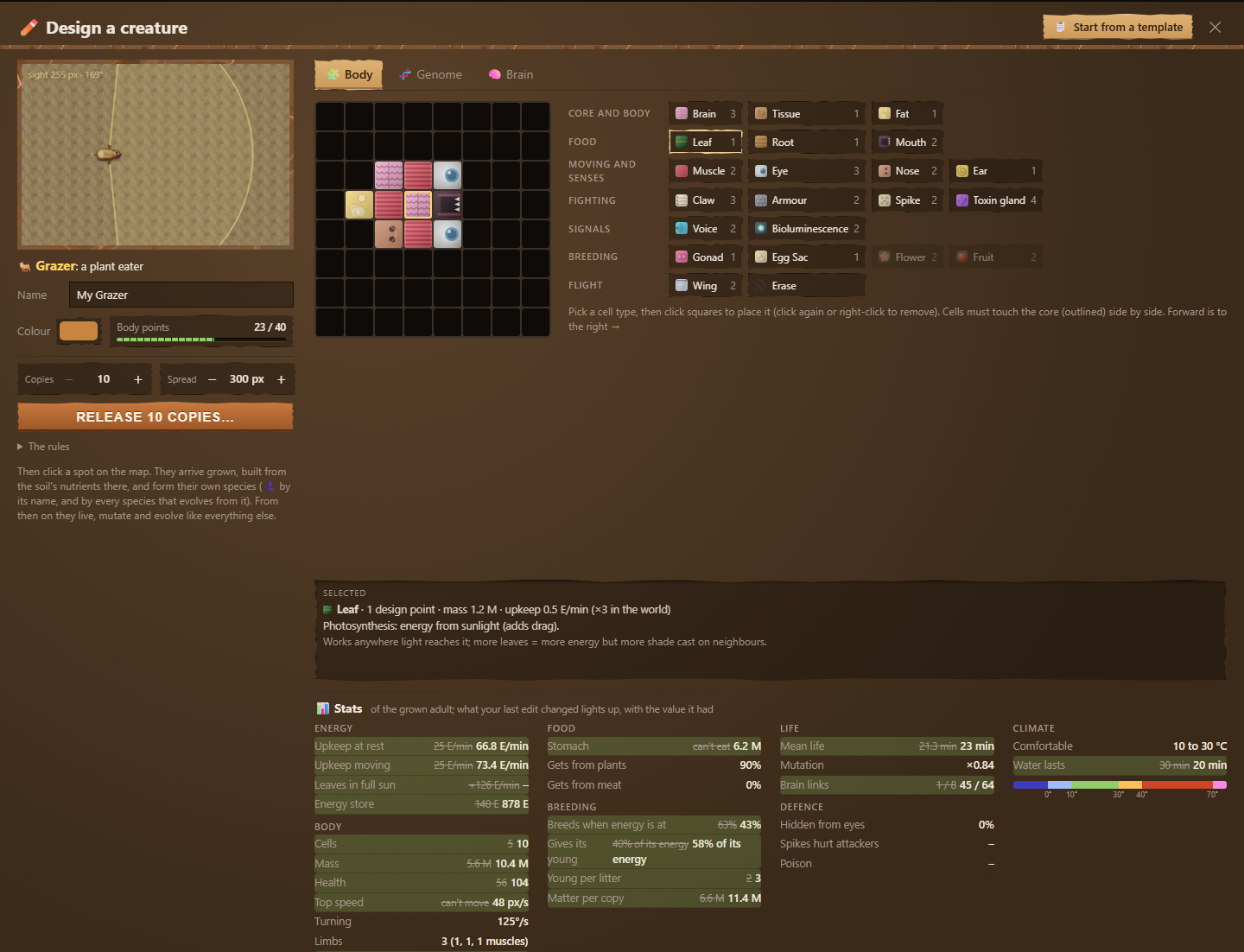 12345678910
- 📋 Start from a template: cards with each template drawn, plants and animals apart (one your level can't design yet shows the level it needs). It replaces the body, genes and brain.
- The preview: your creature as the world will show it.
- What the design is: its category (below).
- Name and colour.
- Body points spent (red when over). Problems with the design show below them.
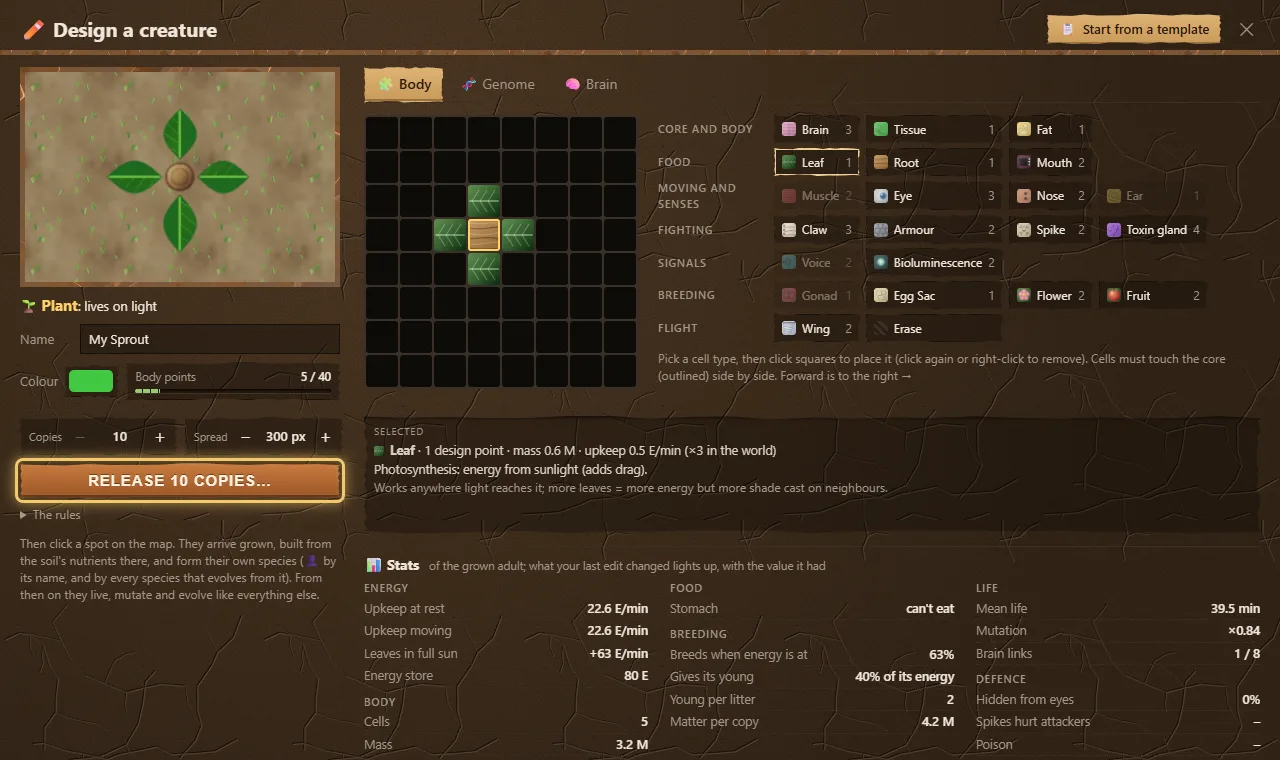
- Copies and Spread, then Release and click a spot on the map.
- The tabs: 🧩 Body, 🧬 Genome (its sliders show at each end what that end suits, e.g. 🔥 heat and ❄️ cold for Insulation; point at an icon to read it) and 🧠 Brain.
- 📊 Stats of the grown adult; what your last change moved lights up.
- The grid: click to place the picked cell, click again or right-click to remove. The core is the outlined centre, forward is to the right.
- The cell palette, with each cell's cost; greyed out when the rules forbid it. Point at a cell or gene to see what it does.
What your design is
| Category | When |
|---|---|
| 🌱 Plant | leaves, no muscles |
| 🌊 Alga | a very aquatic plant |
| 🦌 Grazer | muscles and a mouth, eats plants |
| 🐺 Hunter | muscles and a mouth, eats meat |
| 🐒 Omnivore | eats both |
| 🐟 Fish | a very aquatic animal, no wings |
| 🐦 Bird | muscles and a Wing |
| 🐾 Animal | muscles but no mouth: it can't eat |
Rules
Some cells don't mix, and the designer greys them out and says why: Flowers and Fruit are for plants, a Gonad, Egg Sac and Wings for animals, and an animal needs a Brain at its core. Every cell must touch the body side by side.
🎮 Controlling your creatures
Click a living animal of a species you released (or one that evolved from it) and press Take control in the bar at the top. Its brain switches off and you steer it:
| W S · A D | Forward and back · turn |
| Space (hold) | Bite whatever its mouth touches |
| F (hold) | Strike with its claws |
| R | Breed, when it is ready |
| E | Take off and land, with Wings |
| Esc | Let go |
On a touch screen a stick and buttons appear. It still gets hungry, can be eaten and grows old; control ends when it dies or after a minute without a key.
Tips
- Start from a template and change one thing at a time.
- Watch the adult stats: upkeep against what it can earn decides almost everything.
- Release where your design can live: plants in good light and soil, grazers among plants, fish in the water, hunters where prey is.
🧩 Cells
Bodies are built from cells. Each has a job, a weight and an upkeep, and is food for someone (or isn't).
🎚️ Genes
Genes run from 0 to 100. Each has a gain and a cost, so the best value depends on where and how a creature lives. Organ genes only matter if the body has that organ.
☄️ Events and founders
Now and then a meteorite strikes anywhere: it kills near the centre, hurts around it and leaves a hot crater that cools over time.
Every few sim-days the whole world is struck by one of six events, for hours. See Extinction events.
A world starts with plants and algae. Once there is enough food, the world releases its first animals: plant eaters first, then the hunters and scavengers. In a world you host, the world editor's Founders tab chooses which come and when.
When a whole level nearly dies out, its founders come back, if their food is there, but not right after an extinction event: the survivors get to refill the world first.
🌋 Extinction events
Every 70–90 sim-hours the world is struck by one of six events, picked at random. It builds up, holds for hours, and fades. The species that come through are the ones whose bodies and habits could take it, and the emptied niches are where new ones arise.
A banner under the top bar names the event and shows how long it has left (− shrinks it). The map takes a tint: dark under a dimmed sun, orange in warming, blue in an ice age. In a world you host, the world editor's Events tab sets how often they come, how hard they hit and which kinds may happen.
Meteorites rain down for a short while. Whoever is unlucky suffers, crowded places most. The craters' fertile ground helps plants regrow.
The world gets several degrees warmer, slowly. Bodies made for the heat do well; the land round volcanoes burns first. Refuge: the cold latitudes, where it is felt less.
The world gets much colder and shallow sea freezes. Furry bodies do well. Refuge: the land round volcanoes, which the cold doesn't reach.
Less light everywhere: plants starve, then the plant eaters, then the hunters. Efficient leaves, fat stores and low upkeep help.
One big strike on land, announced a couple of minutes ahead with a countdown. Most are small; a rare giant ends nearly all animal life. After it, dust darkens and cools the world for a while (an impact winter), worse the bigger it was.
A short burst of radiation: births mutate much more, and many die suddenly. The young change fast; lines with a low Mutation rate keep their shape best.
⚡ God mode
Play with the world itself. Tick ⚡ God mode on the start page (the desktop app has it on) and a ⚡ God mode button appears at the bottom of the screen. It opens the actions as tiles; pick one, then click the map. Esc or a right-click puts it away.
Throw one where you click, or press K to throw it where the mouse points.
Press and hold on the map: a beam heats or cools the ground under it while you hold; move it to sweep an area. Its panel sets how hot or cold and how wide. Scorched ground turns to lava, chilled ground to ice, and both fade back to normal over time.
Pick its size (its panel says what each does) and click: it falls and goes off. The blast kills and burns, and its radiation lingers for months: births mutate more and sudden deaths are likelier (A maps it). Enough bombs fill the sky with smoke and start a nuclear winter: a ☢️ bar at the top left shows how close the sky is.
Drop meat where you click, for the meat eaters.
Every creature inside the circle gets full health, energy and water, is cured of poison and is young again.
Shower, Warm, Ice age, Dim and Solar start that event now: pick its length and strength, then start it. 🌠 Asteroid: pick its size and click where it will hit.
In a shared world everyone can use God mode, so what you do, everyone sees. Big strikes shake the screen.
🏅 Levels and evolution points (desktop)
In the desktop app a world you host is either a Sandbox or plays with levels. A Sandbox has everything unlocked, as the online world does. With levels you start with the basic cells and a few God mode actions, and your species earn evolution points (EP) that raise your level and unlock more. Pick it when you make a world: tick Sandbox in the world's settings for a playground. Your level is yours, not the world's: the app keeps it and brings it to every world with levels you play in, yours or a friend's, and every player there plays by their own level and earns their own points. The 🏅 Progress tab shows it, Marles tells you whenever you earn points, and the Info tab says which kind of game a world is.
How you earn points
Only species you released count, together with every species that evolves from them (a line). Each one is paid once per line in each world. Animals pay more, because they are harder to keep going. The points below are for plant eaters; omnivores earn 1.5 times as much, meat eaters, fish and birds twice as much, and plants and algae three quarters. A new species, Still going, A big family and Survivor count by what your line started as; Top of its kind, Top of the world and Something new by the kind of the species that did it (a meat eater on top of the world: 120 EP). A plant or alga line's big family also takes ten times the members.
| A new species | A new species evolves from your line and takes hold (10 members at once): 10 EP (after the first 5 in a world, 5 EP) |
|---|---|
| Still going | Your line still lives 1, 10, 50 and 100 years after you released it: 10, 25, 60 and 120 EP |
| A big family | 100 members alive at once: 15 EP; 1000: 40 EP (a plant or alga line: 1000 and 10 000) |
| Top of its kind | One of your species, with at least 50 members, is the most common plant eater, meat eater, omnivore, fish or bird for a whole year: 30 EP each |
| Top of the world | One of your species, with at least 50 members, is the most common animal of all for a whole year: 60 EP |
| Survivor | Your line lives through an extinction event that came by itself: 50 EP for each kind of event, 80 EP for an asteroid |
| Something new | Your line makes a kind of animal its first species wasn't (a plant eater line that makes a meat eater, a flier, a swimmer or an omnivore): 20 EP each |
God mode doesn't pay: an event you start yourself never counts for Survivor, and for a year after one the Top clocks stand still. A world with no second chances for the founders (none come back once they die out) pays half as much again.
What each level opens
Level 2 takes 50 EP, and each level after that 50 more than the one before (level 3 at 150, 4 at 300, 5 at 500, 10 at 2250).
| Level 1 | Leaf, Root, Tissue, Mouth, Muscle, Eye, Fat and Brain; 40 body points. God mode: Heal, Meat, Meteorite and Meteor shower |
|---|---|
| Level 2 | Nose and Bioluminescence; 45 body points. God mode: Heat ray and Cold ray |
| Level 3 | Claw, Armour and Spike |
| Level 4 | Fruit and Flower; 50 body points |
| Level 5 | Gonad and Egg sac. God mode: Global warming and Dimmed sun |
| Level 6 | Toxin gland; 55 body points |
| Level 7 | Voice and Ear. God mode: Ice age and Solar storm |
| Level 8 | 60 body points. God mode: Asteroid |
| Level 9 | Wing, the last cell. God mode: Atomic bomb |
| Level 10 | 65 body points, and a secret |
| Higher | 5 more body points every second level, up to 80 at level 16 |
Levels limit only what you design: the cells in the designer, your body points and God mode. Evolution is never limited: in any world your species' young can still grow any cell, so your line may evolve Wings or a Voice long before you can design with them. Locked cells show their level in the designer, locked God mode tiles theirs. Someone playing in a browser instead of the app plays a world with levels by level 1 rules.
🤖 AI and the Chronicle
An AI app on your computer, such as LM Studio or Claude Code, can connect to a world: read it, write its history and, if you allow it, design creatures. The game ships no AI: you use your own, and in a world you host it talks only to your computer.
📜 The Chronicle
ℹ️ Info → 📜 Chronicle tells the history of the world in reports of 10, 100 and 1000 years, and Right now: what is happening at this moment. The world writes down the facts itself, so a report can only tell what really happened. An AI turns those facts into a short story about the period and its notable species; until one has, you see a plain summary. Every report is checked against the facts before the game shows it.
🧰 What an AI app can do
| 👀 See the world | The rules, the world now, its species, creatures and places (always on) |
| 📈 History | Populations, events, records and the family trees of species |
| 📜 Write the Chronicle | Read the facts of each period and post its report |
| 🧬 Design creatures | Make new species and release them (off unless you allow it). They show 🤖 by their name |
🔌 Connecting your AI app
- In the desktop app, the world editor's 🤖 AI tab sets it up when you make a world: on or off, and what AI apps may do.
- Start the world and open the 🖥️ Host tab: it shows the lines to copy for LM Studio or Claude Code.
- Paste them into your AI app, then ask it something like “Write the next Chronicle report for this world.”
⚙️ Settings → AI turns it on or off while the world runs. In the Host tab you can also make AI keys, one per AI app, and revoke any of them with a click. With MCP needs a key on, only AI apps with a key can connect, which matters when others on your network can join.
🎨 Reading the map
Press U to switch between the natural look and the cells. The natural look is drawn from what the cells are:
Each limb is a leg, drawn where its muscles are on the body, longer and thicker the more muscles it has; a limb in the middle at the back is a tail. A body with only one limb is a worm.
Brain cells make the head: the more, the bigger. Four or more make an ape, with hands and a curling tail.
Any animal with a Wing is drawn as a bird, with feathers and a beak. In the air its wings spread and it casts a shadow below.
Armour gives scales, and with three or more a turtle's shell. Spikes are quills. Bioluminescence cells are glowing bulbs.
Cold-adapted bodies grow fur, thicker the more they are built for the cold; heat-adapted ones get bare skin and big ears, and plants turn succulent.
Endurance muscles make a broad, heavy body, sprint muscles a slim one. Camouflage gives a dappled coat, poison bright warning bands. Long-sighted hunters get a predator's slit-pupil eyes, and meat eaters show fangs.
Fish have scales and a forked tail; one with five or more limbs is an octopus, with a tentacle for each limb and a head that grows with its brain cells. Algae are seaweed. Animals between land and sea are frogs.
Storms show as cloud shadows, darker when they carry more water (R hides them). Ground hot enough to burn glows as lava.
Signs on creatures
| 🔴 Red ring | being bitten or eaten |
| ☠️ Skull in a green drop | poisoned: losing health until it wears off |
| 🟠 Amber ring | starving |
| 🥚 Speckled egg | an egg; broken halves: a bitten egg |
| 🪽 Spread wings, a shadow below | flying: nothing can touch it until it lands |
| ✨ A glowing bulb | a signal: yellow or blue light others can see |
| 💬 Bubble | speech |
Up close in the natural look (with Bite particles on), claws reach out when a strike lands, a mouth snaps open and shut as it eats, a pink heart floats over an animal ready to breed, droplets splash at the mouth of an animal drinking, and seeds fly from a plant to where a new one sprouts.